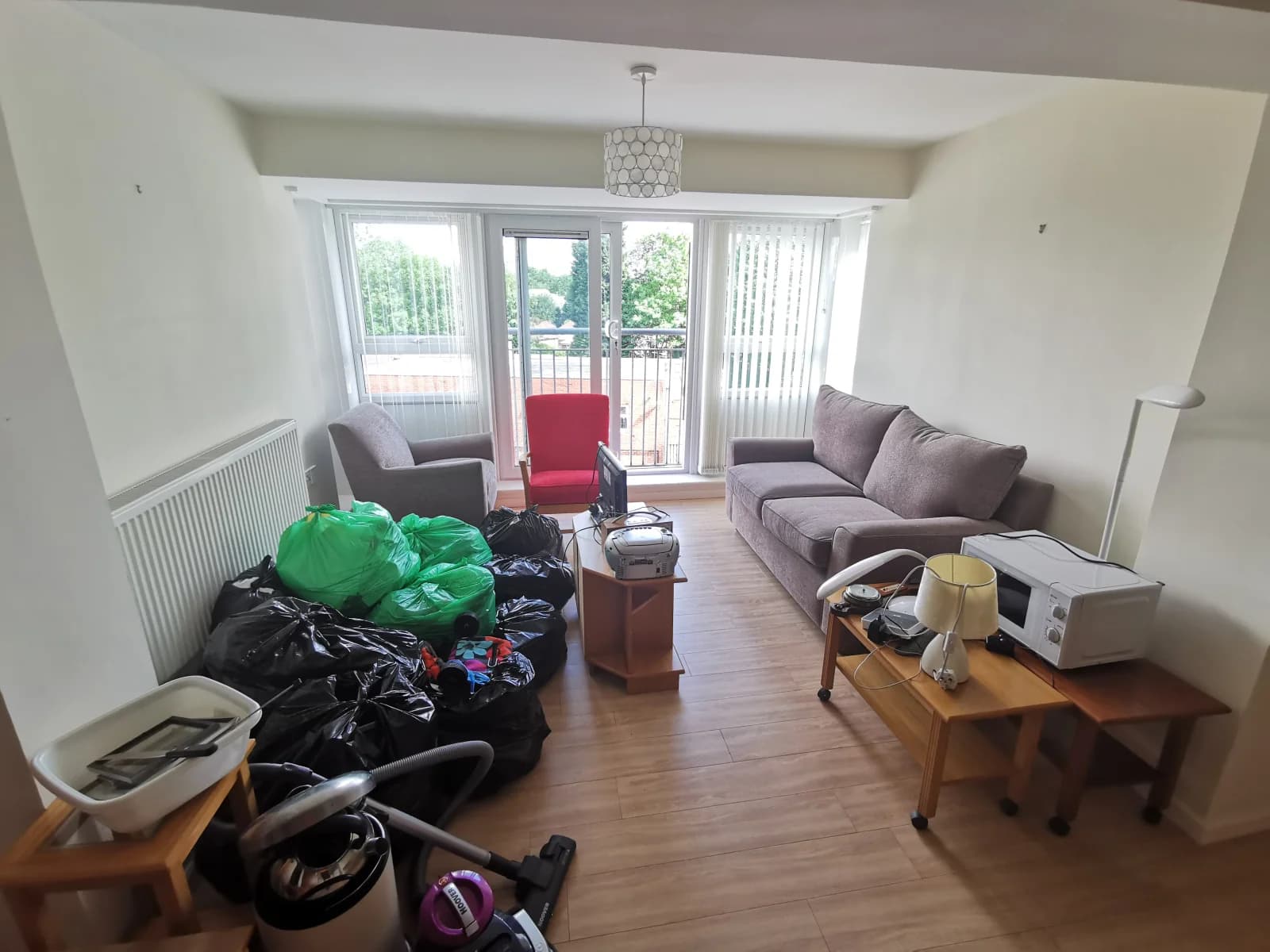

Some house clearances are just logistics. A rented flat needs emptying, a sofa has to go, and the only real questions are access and price. Others are nothing like that.
Clearing a parent's home after the funeral. Emptying a house so probate can move forward. Helping someone whose home has become too full to live in safely. These jobs involve people's lives and memories, not just their belongings, and they deserve to be handled differently.
It is work The Waste Removers handle regularly, and this guide explains how it works in practice: what to expect on the day, what is worth sorting out before anyone lifts a box, and how to choose people you can trust inside the home.
For the standard enquiry, quote, loading and paperwork stages, see our main guide to how house clearance works. The guidance below focuses on the extra care needed in difficult circumstances.
If you would rather just talk it through first, call 0161 989 5446. You do not need to have everything sorted before getting in touch.
Quick answer
A sensitive house clearance is a standard house clearance handled with more care, clearer instructions and a slower pace where needed. Before the team arrives, decide what stays, what goes, what should be set aside, and flag any lofts, garages, sheds, paperwork, hazardous items or access issues.
Questions this article answers
What is a sensitive house clearance?
How long does a sensitive house clearance take?
Do I need to be at the property during the clearance?
What happens if money, jewellery or documents are found during the clearance?
Can you clear just part of a house?
Is there anything that cannot be included?
What paperwork do I get afterwards?
Before clearance day, try to:
- Remove wills, ID, bank letters, deeds and important paperwork
- Move definite keepsakes into one labelled place
- Agree what stays, what goes and what should be set aside
- Mention lofts, cellars, sheds, garages and outbuildings
- Flag paint, chemicals, gas bottles, oils or suspected asbestos
- Confirm keys, alarm codes, parking and who will provide access
- Decide whether you need before and after photos
What is a sensitive house clearance?
A sensitive house clearance is a house clearance carried out with extra care because of the circumstances behind it. Most often that means a bereavement, a probate or inherited property, a move into care, or a hoarded home. It is not a separate specialist service: it is the same house clearance work, delivered with a different pace, more communication and careful handling of personal items.
Situations where this approach matters include:
- Clearing a home after someone has died
- Emptying a property for probate or as part of an estate
- A parent or relative moving into residential care
- A hoarded or very full home
- Downsizing after decades in the same house
- A separation or other difficult family change
- Arranging a clearance from the other end of the country
The common thread is that the person arranging the work is usually carrying more than the practical task. There may be grief, family decisions, legal deadlines or simple exhaustion in the background. A clearance company that understands this lets you set the pace.
At The Waste Removers, this is covered by our core house clearance service, with the pace, communication and set-aside approach agreed around your situation.
How a sensitive house clearance works, step by step
The process is straightforward, and you do not need to know exactly what needs removing before you speak to us. A typical job runs like this:
- You send photos of the rooms, or arrange a visit if photos feel like too much. Lofts, garages, sheds and cellars are worth mentioning even if you have not been in them.
- Together you agree three groups: what stays in the property, what goes, and what should be set aside for the family to look through later.
- You get a written quote covering labour, loading, disposal and VAT, so there are no surprises afterwards.
- On the day, the team works room by room. Anything that looks personal or important goes into the set-aside area rather than the van.
- Items in usable condition are separated for reuse or recycling where practical, rather than everything being treated as waste.
- Afterwards you receive a digital waste transfer note and invoice, plus completion photos if you want them for family members, a solicitor or an estate agent. Households are not legally required to keep a transfer note, but it is useful proof that the waste was handled properly.
Nothing about that process should feel rushed. Plenty of jobs start with a single room and grow from there.
Clearing a home after a bereavement
There is no right timetable for this. Some families want the house cleared quickly because walking past it hurts. Others need months before they can face the front door. Unless there is an external deadline, like a tenancy ending or a sale completing, go at the speed that works for you.
One piece of advice we give everyone: do the document hunt before the clearance, not after. Wills, ID, bank letters, insurance policies and Premium Bonds turn up in strange places. Kitchen drawers, biscuit tins, coat pockets, under mattresses, inside books. Set aside a visit just for this, and take a second person with you if you can. Two pairs of eyes miss less, and it is easier with company.
It also helps to move the things you already know you want to keep into one room, or out of the property entirely, before the clearance team arrives. That way nothing precious depends on a split-second decision on a difficult day.
Do the document hunt first
Paperwork and keepsakes turn up in ordinary places: kitchen drawers, coat pockets, books, tins, bedside cabinets and under mattresses. A separate visit just for documents can prevent regrets later.
Probate and inherited properties
When a property is part of an estate, the clearance usually needs a paper trail. Executors often want photos before and after the work, an itemised invoice, and the waste transfer note for the estate records, especially when several family members are involved or money from the estate is paying for the work.
Access is rarely a problem. Keys can be collected from a solicitor, an estate agent or a neighbour, and instructions can be agreed in writing so everyone involved can see what was asked for.
While the property is empty, two small jobs save trouble later: tell the home insurer the property is unoccupied, because many policies change once a house is empty, and redirect the post so nothing important goes missing.
Hoarded or very full homes
A hoarded property is not a mess to be judged. There is usually a person and a story behind it, and there are almost always important things buried in the contents: documents, cash, jewellery, photographs. Clearing a home like this in one impatient sweep risks losing all of them.
Staged clearances work better. Create safe access first, remove the obvious waste, then slow down as the layers come off and more personal items start appearing. Where the person who lives there is involved, they should keep as much control over the decisions as possible. Progress that sticks usually beats speed.
What can go, and what needs flagging first
Most household contents can be cleared in one job: furniture, beds and mattresses, sofas, wardrobes, white goods, clothing, books, carpets, kitchen contents, loft and garage items, garden bits and bagged general waste.
Some things cannot travel as part of a standard clearance load. Paint, chemicals, gas bottles, oils and fuels need to be mentioned when you ask for a quote, because they may need a different disposal route. If you suspect asbestos anywhere, often in older garages, sheds or floor tiles, say so before booking and leave it untouched; it is not something a standard house clearance should handle. Flagging these early means an honest answer up front rather than a problem on the day.
Flag hazardous items before booking
Do not wait until the day to mention paint, chemicals, gas bottles, oils, fuels or suspected asbestos. Some items need a separate disposal route and should not be moved as part of a standard house clearance.
What happens to personal items, documents and valuables?
This is the question people worry about most, and the answer should be simple: anything personal gets set aside, not loaded.
Before the work starts, tell the team what to look out for: photographs, paperwork, jewellery, keys, medals, anything with family history attached. During the clearance, items like this go into an agreed safe spot or are boxed for the family to review. If something valuable turns up that nobody expected (cash inside a book, documents at the back of a wardrobe), it should go straight to you or your nominated contact.
Use a set-aside area
Choose one room, corner or labelled box for anything the team should not load. That simple instruction is often clearer than trying to make decisions while the clearance is moving.
Where items are in good condition but not wanted, reuse and recycling come before disposal. At The Waste Removers, separating reusable and recyclable items where practical helps us divert over 95% of what we collect from landfill.
If you cannot be there, or cannot face being there
Plenty of sensitive clearances are arranged entirely remotely. Executors living hundreds of miles away, families coordinating between siblings, agents managing the sale. Photos, written instructions, key collection and updates during the day make it work, with completion photos and digital paperwork at the end.
There is also a quieter version of this: some people could attend but would rather not be in the house while it happens. That is completely normal. Hand over the keys, go and do something else, and come back to a property that is one step closer to being dealt with.
What affects the cost?
Four things drive the price of any house clearance: how much there is to remove, how long it takes to carry and load, how awkward the access is, and what the disposal routes cost. Stairs, long carries, limited parking and very full lofts add labour time. Certain items, such as fridges and mattresses, carry their own disposal costs because they are processed separately.
Photos are the quickest way to an accurate figure. A quote based on real photos of real rooms means the price is agreed before anyone arrives, which is one less thing to think about on the day.
A short checklist before clearance day
- Find and remove important documents first: wills, ID, bank letters, deeds
- Move definite keepsakes into one labelled room, or out of the property
- Agree in writing what stays, what goes and what gets set aside
- Mention lofts, cellars, sheds and garages, even if you have not looked inside
- Flag paint, chemicals, gas bottles or anything you are unsure about
- Sort out keys, alarm codes and who will provide access
- Check parking for a van as close to the door as possible
- Decide whether you want before and after photos for your records
Choosing who to let into the home
This is the part worth being fussy about. Whoever does this work will be alone with a family's belongings, so price should not be the only thing you compare.
Check the company is a registered waste carrier. You can look any business up on the Environment Agency's public register, and a legitimate firm will give you its registration number without hesitation (ours is CBDU609834). Ask for a written quote, check they are insured, confirm you will get a waste transfer note afterwards, and pay attention to how they speak to you on the phone. If they rush you in the first conversation, they will rush you in the house.
Be cautious with van adverts on social media from collectors who cannot show they are registered waste carriers. If your waste ends up fly-tipped, it can be traced back to you, and that is a legal problem you do not need on top of everything else.
If you want to understand the rules in more depth, our guide to legal waste disposal and avoiding fly-tipping fines explains your duty of care and how to check a carrier in plain English.
A sensitive house clearance should feel organised, respectful and calm, and it should leave you with one less thing to carry. However you decide to approach it, take the personal things out first, keep the paperwork, and work with people who treat the home like it still matters. It does.
You don't need a plan to call
You may know exactly what needs clearing, or only that something needs to be done. Either is fine. Call 0161 989 5446 and tell us the situation. We will listen, explain the options and give you a clear idea of what the clearance involves, with no pressure to book.