
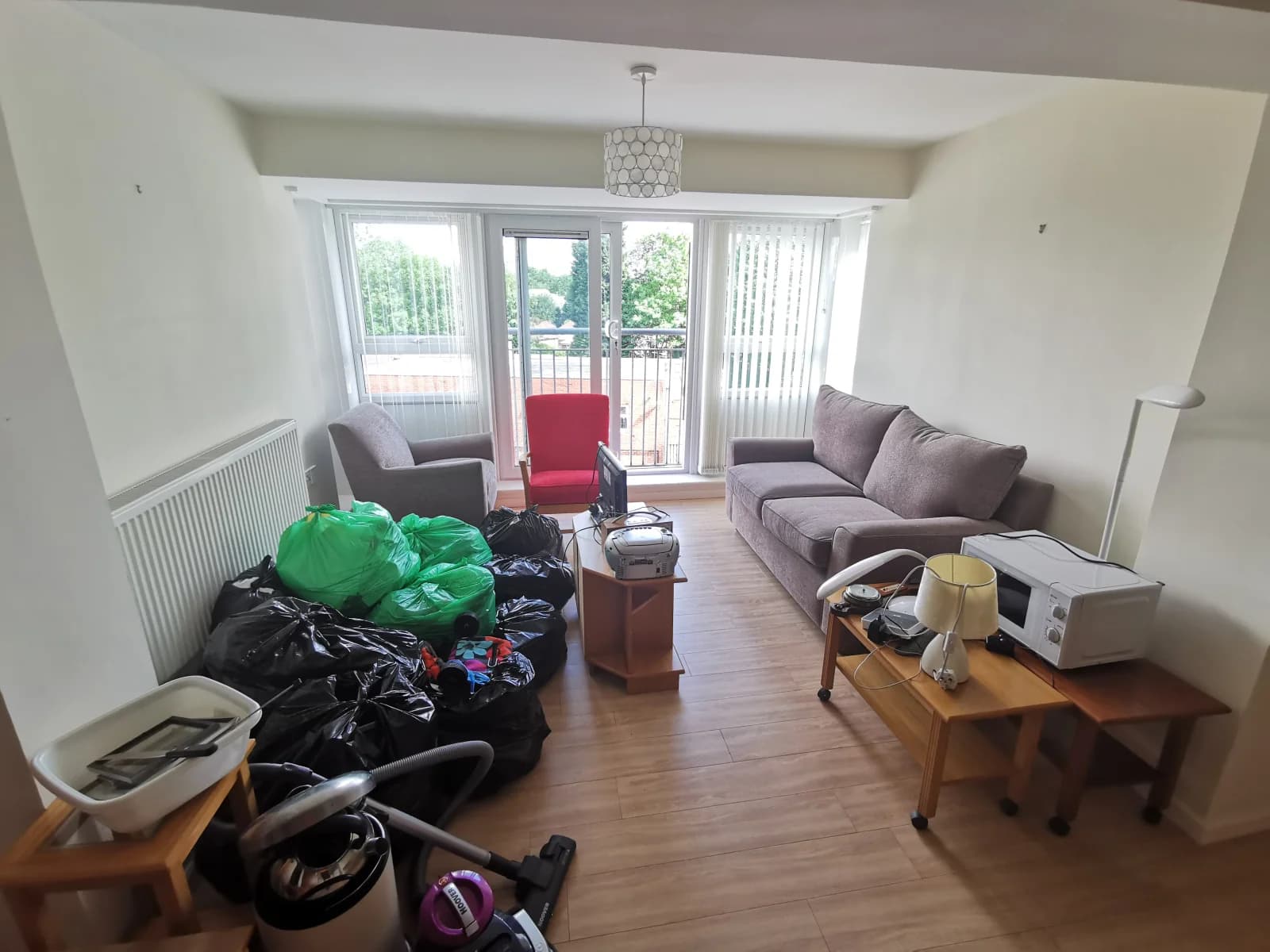
A house clearance normally begins with photographs of every room or storage area you want cleared. You also explain what must stay, flag heavy or restricted items and describe the access. The company can then assess the work, confirm the price and book the right team and vehicle.
You do not usually need to move everything outside. On the day, the team checks the keep-and-remove instructions, carries the agreed items out where access is safe, then sorts them for reuse, recycling or lawful disposal. Afterwards, you receive the paperwork and any completion evidence agreed when you booked.
The process in one sentence
Show what needs clearing, mark what must stay, agree the written quote and date, then let the team load the contents and send each waste type to the correct destination.
What is a house clearance?
A house clearance is the removal of unwanted contents from a home, with the lifting, carrying and loading included. It may be needed after a tenancy, before a sale, during a move or when dealing with a property after a bereavement.
It does not always mean emptying the whole property. Before accepting a quote, list every area included—especially cupboards, fitted storage, lofts, garages, sheds and outside spaces that are easy to miss in photographs.
| Type | What it normally means |
|---|---|
| Full house clearance | Removing most or all agreed contents from the rooms and storage spaces listed in the quote. |
| Partial clearance | Clearing selected rooms, categories of belongings or marked items while other contents remain. |
| Several bulky items | A smaller collection of furniture, appliances or other large objects rather than a room-by-room clearance. |
| Garage, loft or outbuilding | A clearance focused on stored contents outside the main living areas, subject to safe access. |
If you only need a sofa, wardrobe and mattress removed, ask for a bulky-item collection. A house clearance is more suitable when the team must work through rooms, cupboards or stored contents to an agreed brief.
If you are comparing the practical service with other removal options, our house clearance service page explains what The Waste Removers can remove, what is excluded and how to request a quote.
How does the house-clearance process work?
Most clearances follow the same eight steps. Accurate information at the start reduces the risk of a revised price, the wrong vehicle arriving or an item being left because it needs specialist handling.
Make the initial enquiry
Give the postcode, property type, areas to be cleared, preferred date and whether you will be present. Mention any sale, tenancy, probate or key-return deadline.
Send photographs or arrange an assessment
Photograph each room from more than one angle. Include cupboards, lofts, garages, sheds, outside waste, stairs and the route to the loading point. A large or hard-to-assess job may need a site visit.
Receive the quotation
The quote should reflect volume, weight, waste types, labour and access. Check what it covers, whether VAT and disposal are included, and what could change the price.
Confirm what stays and what goes
Use labels, a written room list or one clearly marked keep area. Identify documents, photographs, keys and keepsakes before work starts.
Book the clearance
Agree the date, parking, keys and site contact. If you cannot attend, confirm how the team will gain access, who can answer questions and whether you need completion photographs.
Load and remove the contents
The team checks the brief and carrying route before removing the agreed items. If it finds hazardous, unsafe or unlisted material, loading should pause until you have agreed what happens next.
Sort for the correct destination
Reusable items are separated when there is a suitable outlet, recyclables go to the appropriate facility and specialist waste is kept apart. Anything left must still go to an authorised disposal site.
Receive paperwork or completion evidence
Afterwards, you should receive an invoice or receipt and any relevant waste documentation. If you are not attending, agree completion photographs or a room-by-room update in advance.
Before loading starts, walk through the included areas with the team and repeat the keep instructions. Confirm whether cupboards, carpets, sheds and appliances are in scope. If the contents differ materially from the photographs, agree any change to the price or plan before work continues.
Do you need to sort everything beforehand?
No. If loading from inside is included and the access is safe, you do not need to carry everything to the kerb or move heavy furniture yourself. Doing so can block hallways and make it harder to tell which room an item came from.
Your keep instructions do need to be unambiguous. Remove valuable personal items where possible, or put everything that must remain in one clearly marked area. Label furniture that is staying in an otherwise cleared room and repeat the instruction during the arrival walk-through.
Decide whether drawers, cupboards and boxed contents are included rather than leaving the team to guess. Check medicines, passports, financial papers, photographs, jewellery and keys before the clearance date. Food, liquids and unidentified containers should be pointed out because they may need different handling from ordinary dry household contents.
A useful rule
Do not assume the team will know that an unmarked item is important. Written instructions and a clearly marked keep area protect both you and the clearance crew.
How is a house clearance priced?
House clearances are usually priced for the particular job rather than by property size alone. Two similar houses can produce very different quotes if one has light boxed contents and easy parking while the other contains dense books, heavy furniture, stairs and a long carry to the vehicle.
| Factor | Why it matters |
|---|---|
| Volume | The amount of vehicle space the contents are likely to use. |
| Weight | Dense materials can affect handling, vehicle limits and disposal charges. |
| Item type | Furniture, appliances, mattresses and specialist waste streams can follow different routes. |
| Disposal charges | Authorised facilities charge according to the material and treatment required. |
| Access | Narrow entrances, lifts, restricted loading and difficult parking can slow the work. |
| Stairs | Upper floors and loft access add carrying time and may need a larger team. |
| Carrying distance | A long route between the property and vehicle increases labour and loading time. |
| Labour | Large, awkward or dismantled items may require additional people and time. |
| Specialist items | Hazardous, electrical, upholstered or unusually heavy items may need separate handling. |
To compare companies fairly, send each one the same photographs, item list and access information. Ask for a written quote that explains what is included and what could be charged separately.
Check whether the team will empty cupboards, carry from upper floors, dismantle suitable furniture and include disposal charges. A quote that assumes everything is already outside is not comparable with a full labour-and-disposal service.
How long does a house clearance take?
The time depends on the amount being removed, how far it must be carried and how much sorting or dismantling is required. A partial ground-floor clearance with nearby parking may take a few hours. A full property with loft contents, several upper floors, outbuildings or restricted loading may need a full day or more than one visit.
Ask for a working window based on the contents and access, not just the number of bedrooms. Photographs of stairs, lifts, gates, corridors and parking help the company estimate loading time more accurately.
What happens to the items afterwards?
A lawful clearance does not end when the vehicle leaves the property. The contents must be taken to authorised destinations, and different materials may need different treatment. Suitable items can be considered for reuse, while metals, wood, cardboard, electrical equipment and other recoverable materials may be separated for recycling where facilities accept them.
Some common household items follow specialist waste streams. Fridges and other electrical equipment require appropriate treatment. Mattresses are normally kept separate for their own route. Upholstered domestic seating may have to be managed as waste containing persistent organic pollutants rather than mixed with general bulky waste.
Not every usable-looking item can be donated. Charities and reuse outlets may reject furniture because of its condition, cleanliness, missing fire labels, low demand or lack of storage. Ask how the company separates suitable items, but be wary of a promise that everything will be reused.
Our guide to POPs waste and upholstered furniture disposal explains why old sofas and padded seating must be kept separate and what that means for a clearance.
For the wider duty-of-care position, carrier checks and fly-tipping risks, read our guide to legal waste disposal in the UK.
What paperwork should you receive?
You should at least receive a clear invoice or receipt identifying the company. Waste-transfer documentation may also be relevant, depending on who produced the waste and how the collection was arranged. If you need completion photographs or an inventory summary, agree this before the job.
Landlords, agents, executors and businesses may need a fuller audit trail than a householder. Give the company any required names, property references or purchase-order details before it issues the invoice.
Whoever you use, check that the person taking the waste is authorised; do not accept a registration number without verifying it. The Waste Removers is registered as an upper-tier waste carrier under CBDU609834. After a completed collection, we provide an invoice and Digital Waste Transfer Note, plus completion photographs when agreed.
You can verify a company name or registration number using the Environment Agency's public register.
How do you choose a house-clearance company?
Choose the company that gives clear, checkable answers. It should ask what is being removed, inspect the access, flag items needing separate handling, identify who will carry the waste and explain what happens if the actual load differs from the photographs.
Use our full checklist of questions to ask a house-clearance company before booking when comparing quotes, paperwork and disposal arrangements.
What about sensitive or bereavement clearances?
A bereavement clearance needs a careful brief and enough time to check for photographs, documents, jewellery, keys and items promised to relatives. It may also be arranged remotely through a solicitor, agent or key holder.
Agree where uncertain items will be set aside and name the person who can answer questions. If nobody will be present, use written instructions and request completion photographs. Even with a sale or tenancy deadline, the team should work through the property room by room.
Our practical guide to sensitive house clearances covers bereavement, probate, keepsakes, remote access and working at a manageable pace in more detail.
House-clearance booking checklist
Before accepting the quote:
- Photograph every room from enough angles to show the amount being removed
- Include cupboards, garages, lofts, sheds and outside areas in the scope
- List unusually heavy, awkward, electrical or restricted items
- Explain stairs, lifts, gates, carrying distance, access and parking
- Remove or clearly mark everything that must remain
- Mention sale, tenancy, probate or key-return deadlines
- Confirm the quoted price and what labour, VAT, disposal and paperwork it includes
- Agree keys, the site contact and any completion photographs before the day
Planning a house clearance?
Send photographs of the rooms, storage spaces, access route and any heavy or unusual items. Tell us what must stay and your deadline, and we will confirm what can be included before you book.