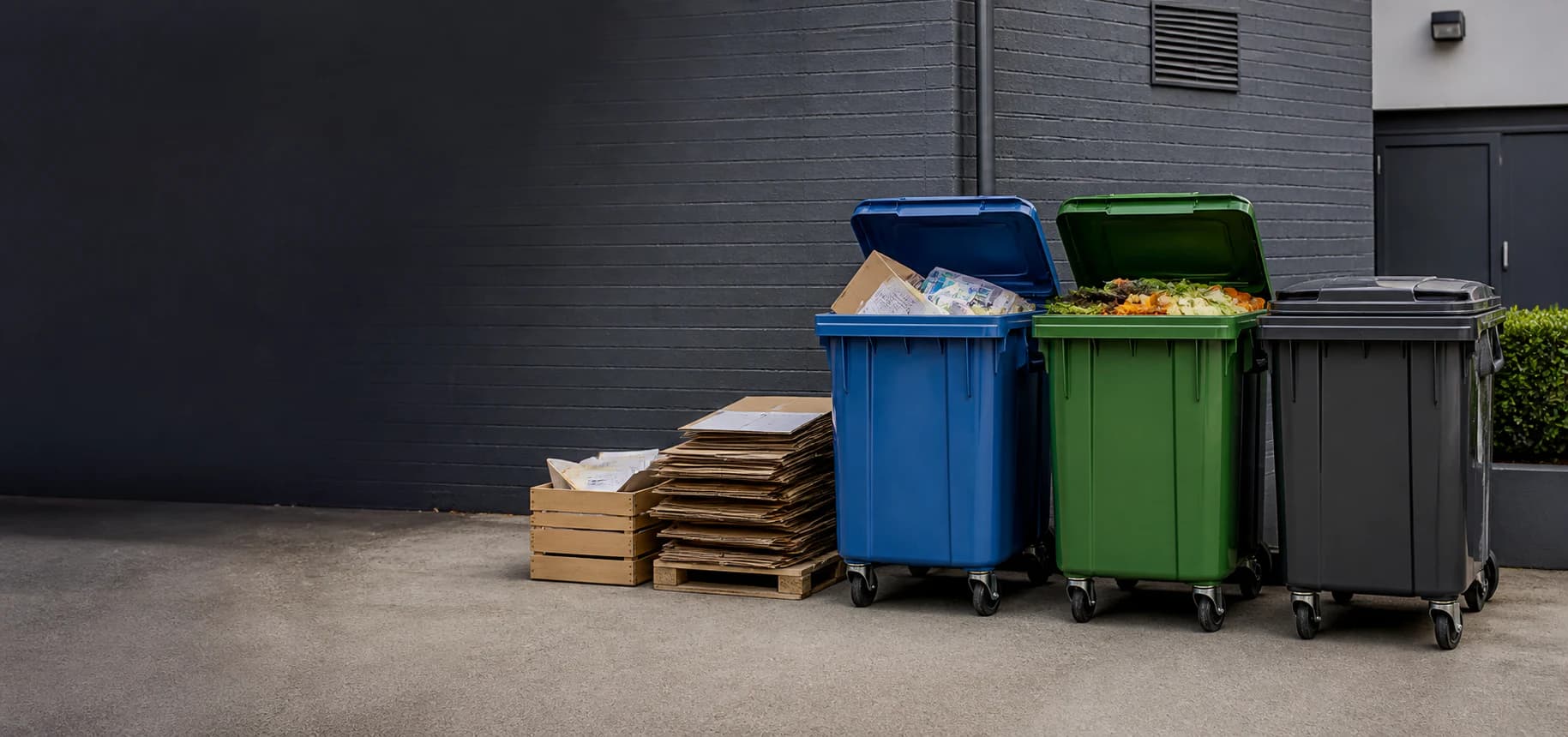
Since 31 March 2025, workplace recycling rules have applied to businesses and other organisations in England unless they qualify for the temporary exemption for existing micro-firms.
Compliance depends on three details: whether your deadline has passed, how your collector wants the waste presented and which apparently recyclable items are excluded from the standard dry recycling stream.
The short answer
Workplaces in England must keep dry recyclable materials, food waste and residual waste separate before collection. Businesses that existed on 31 March 2025 and had fewer than 10 full-time equivalent employees are exempt until 31 March 2027. Businesses established after 31 March 2025 do not receive that exemption.
What are the workplace recycling rules?
The rules are part of Simpler Recycling, introduced to make the core materials collected for recycling consistent across England. They cover waste from employees, customers and visitors, including the bin in a staff kitchen and the bins beside a cafe counter.
A workplace must present the required waste streams separately in line with the arrangements made with its collector. You can use separate bins for each type or separate the waste before collection, with container sizes and collection frequency matched to the amount you produce.
The detailed requirements and current material lists are set out in the government's Simpler Recycling workplace guidance. The guidance applies to England; Scotland, Wales and Northern Ireland have their own waste and recycling rules.
Separation sits alongside your wider business waste duty of care. You must still store waste securely, use an authorised carrier, describe it accurately and keep the required records.
Which workplaces must follow the rules?
The rules cover businesses, charities and public sector organisations producing waste similar in nature and composition to household waste. Named examples include offices, shops, cafes, restaurants, hotels, warehouses, workshops, construction sites, schools, healthcare premises, places of worship, care homes and temporary event venues.
| Workplace | Deadline | Position in August 2026 |
|---|---|---|
| Business in existence on 31 March 2025 with 10 or more full-time equivalent employees | 31 March 2025 | Rules already apply |
| Business in existence on 31 March 2025 with fewer than 10 full-time equivalent employees | 31 March 2027 | Temporary exemption still applies |
| Business established after 31 March 2025 | From the start of trading | No micro-firm exemption, regardless of employee count |
For a business that existed on 31 March 2025, its full-time equivalent employee count on that date decides whether the temporary exemption applies. Waste volume is irrelevant to the threshold.
Does your business count as a micro-firm?
For this exemption, an existing business is a micro-firm if it had fewer than 10 full-time equivalent employees when the regulations came into force on 31 March 2025. Count employees across the whole business, not branch by branch. A company with five employees at each of three shops has 15 employees in total.
Full-time employees count as one each. For part-time employees, the statutory calculation uses hours worked over the previous 12 weeks as a proportion of the contracted hours of a full-time employee. Government guidance confirms that volunteers, contractors and self-employed workers do not count. An eligible micro-firm does not need to register or apply for the exemption, but it must comply from 31 March 2027.
Check when the business started
A business created after 31 March 2025 cannot claim the micro-firm exemption, even if it has fewer than 10 full-time equivalent employees. Eligible existing micro-firms remain subject to the business waste duty of care during the exemption.
What waste must be separated?
Separate waste into three main groups: dry recyclable materials, food waste and residual waste. Garden waste has an additional rule where a workplace produces it. Your collector may divide the dry materials further, so agree the container arrangement before buying bins.
| Waste stream | Typical contents | Keep separate from |
|---|---|---|
| Dry recycling | Empty glass bottles and jars, metal cans and tins, accepted plastic packaging, paper and cardboard | Food waste and residual waste |
| Food waste | Meal leftovers, fruit peel, tea bags, coffee grounds and food-preparation scraps | Dry recycling and residual waste |
| Residual waste | Non-recyclable items and recycling that is too contaminated to process | Dry recycling and food waste |
| Garden waste | Plant and grounds-maintenance material | Arrange recycling or composting where that gives the best environmental outcome |
Plastic, metal and glass can usually be collected together if that is how your collector operates. Paper and card should normally be collected separately from those materials. A collector may combine them only where it has completed the required written assessment showing separate collection is not technically or economically practicable or brings no significant environmental benefit.
The collector completes that assessment. It does not give a workplace general permission to put everything in one bin. Follow the collection arrangement you have been given and keep the service information that explains which materials belong in each container.
Plastic film changes in March 2027
From 31 March 2027, plastic film packaging and plastic bags join the plastic recyclable waste stream for workplace collections. Existing micro-firms also lose their temporary exemption on that date.
Food waste rules for small quantities
Every workplace in scope must separate food waste, even if it serves no food and has no commercial kitchen. A few tea bags, coffee grounds, banana skins or staff lunch leftovers still count. Asking employees to take food waste home does not meet the requirement.
Place food-waste containers where the material is produced, normally in staff rooms, kitchens and customer eating areas. Collection frequency can reflect the volume, but storage must not create odours or attract pests. Government guidance recommends storing food waste for no more than two weeks.
Compostable packaging is not food waste
Packaging labelled compostable or biodegradable does not go into the standard food-waste collection. Treat it as residual waste unless you have arranged a dedicated collection. Food-caddy liners can be accepted with food waste, subject to your collector's instructions.
Bins used by customers and visitors
Waste deposited by customers and visitors is covered. If you provide front-of-house bins, the contents still need to be separated before collection. Matching recycling and residual bins placed together, with clear signs and openings suited to the material, are easier for people to use correctly than a recycling bin positioned on its own.
Government guidance recommends separate customer-facing bins where food or recyclable waste is likely to be discarded. If customers mix the waste, the workplace must still separate it before collection. Placing clearly labelled bins together usually prevents more contamination than sorting a mixed bin later.
Items excluded from standard dry recycling
An item's material alone does not make it suitable for the standard dry-recycling collection, which mainly takes packaging and familiar container items. Drinking glasses, mirrors, window glass, ceramics and light bulbs do not belong in the glass stream. Electrical equipment, batteries, vapes, pots and pans, and packaging contaminated with paint, oil or chemicals do not belong in the metal stream.
Common plastic exclusions include expanded polystyrene, PVC packaging, bulky rigid plastic and electrical items. Tissues, wet wipes, hygiene products and books are not normally accepted with paper and card. Some of these materials can be recycled through specialist services instead.
Dealing with contaminated recycling
Contamination means the wrong material is in a recycling container or accepted packaging still contains enough food or liquid to prevent recycling. It can cause a collector to reject the container or charge more because the load must be handled as residual waste.
Use clear signs, position related bins together and check where repeat mistakes happen. If a recyclable load is significantly contaminated before collection, government guidance says to dispose of it as general waste and discuss the problem with the collector. Do not quietly move obviously contaminated material into a clean recycling load.
Choosing a collector and keeping records
You can use a private company, your local authority or more than one provider for different streams. Check every private collector on the Environment Agency's public register and note the date. The waste producer remains responsible when a landlord or facilities manager arranges the service.
When non-hazardous business waste passes to another holder, each load must be covered by a waste transfer note or a document carrying the same information. Our guide to waste transfer notes explains the required fields, signatures, classification codes and two-year retention period.
If you are unsure how to verify a company, the guide to legal waste disposal and avoiding fly-tipping fines covers carrier checks and the warning signs of an unverified collection.
How do the rules affect a one-off business clearance?
Where an office move, shop refit or stockroom clearance includes recyclable waste similar to household waste, such as cardboard packaging, the same separation rules apply. Keep that material apart from residual waste and food waste before collection. Furniture, fixtures, electrical equipment and hazardous items may fall under different waste rules.
Tell the clearance company what is present and ask which materials need a separate route. WEEE must be classified correctly, and batteries, fluorescent tubes and other hazardous waste need appropriate handling and records. Paper records or devices containing personal data must be destroyed securely. Accurate photographs help the carrier plan the load and describe it correctly on the paperwork.
Use our step-by-step office clearance checklist to turn those requirements into a plan for a move, refit or lease handback, including item sorting, WEEE, confidential records, access details and the evidence to keep afterwards.
Match the collection to the job
The Waste Removers handles suitable one-off and ad hoc commercial clearances. For routine bin contracts or separate food-waste collections, use a suitable commercial collector or your local authority.
Compliance notices and enforcement
The Environment Agency can issue a compliance notice where a workplace, landlord, facilities manager or private collector is not following the separation requirements. Anyone can report suspected non-compliance, including evidence of materials being incorrectly mixed.
Failing to comply with a notice is an offence and may lead to enforcement action. Document your collection arrangements, give staff clear instructions and deal with recurring contamination before it causes a rejected load or an inspection problem.
Official sources
Workplace recycling checklist
Use this to review your current setup:
- Calculate full-time equivalent employees across the whole business, not site by site
- Record whether the rules already apply or the micro-firm deadline is 31 March 2027
- List the dry recycling, food waste and residual waste produced at each premises
- Ask your collector how paper and card should be presented
- Put food-waste containers wherever staff or customers produce food waste
- Check customer and visitor bins as well as staff-only areas
- Use clear signs and monitor recurring contamination
- Arrange specialist routes for WEEE, batteries, lights, chemicals and other excluded items
- Check private collectors on the public waste carrier register
- Keep waste transfer notes and collection records where they can be produced quickly
- Identify separate streams before any one-off office or commercial clearance
Need a one-off commercial clearance?
Send photographs of the waste, tell us how it is currently separated and flag electrical, bulky or unusual items before booking. We can quote for a suitable one-off or ad hoc clearance and issue a Digital Waste Transfer Note after the completed collection.